.png)
%20(1).png)


5 Things I Saw in My Classroom That Led to the Amelia’s Loose Part Art Series
- Angela Odusanya

- Jan 25
- 5 min read

Amelia’s Loose Part Art was always meant to be a series. It had to be.
Loose parts play is not simple or one-dimensional. It is a theory filled with nuance, trust, risk-taking, creativity, and problem-solving. Over time, I began noticing that many children were arriving at school without the foundational skills needed to fully engage in open-ended play. And because loose parts do not come with instructions, those gaps were becoming more visible.
Play is supposed to come naturally to children. Yet I was seeing more students unsure of what to do when materials were placed in front of them without directions.
This series was created in response to five specific things I was seeing in my classroom, and each book was intentionally designed to build on the last, helping children slowly develop the skills needed to engage confidently in loose parts play.
1. A lack of willingness to try
Learning depends on risk-taking. If a child is afraid to try, learning cannot happen.
I often saw children hesitate when presented with open-ended materials. They would wait for instructions, ask if they were “doing it right,” or avoid starting altogether. This hesitation was often rooted in a lack of confidence rather than a lack of ability.
In the series, Amelia models what it looks like to try something new. She uses positive self-talk and takes risks in her play. Children see her attempt ideas without knowing exactly how they will turn out, helping normalize the idea that trying is part of learning.

2. A lack of persistence after failure
Success rarely happens on the first attempt. Yet many children were giving up after one failed try, deciding they “couldn’t do it” and disengaging completely.
To address this, Amelia does not get everything right the first time. She experiences moments where her ideas do not work as planned. She reflects, adjusts, and tries again. She thinks out loud so children can hear how ideas evolve and how problems can be solved.
This models persistence in a way that feels relatable and achievable for young learners.

3. Not viewing themselves as capable, even in art
I noticed many children had a very narrow definition of what art encompasses. If they didn’t view themselves as being good at drawing or painting, they believed they were not artists or creative. This often led to them disliking art.
The series intentionally shows that art can look like many things and can be created in many ways. Amelia starts creating art with loose parts in book 1 because loose part art allows children to feel comfortable taking risks in the art process. If they are not satisfied with the way it is turning out, they can simply rearrange the pieces without any evidence of a mistake.
In each book, her understanding of what art is expands, showing children that art is much more that painting and drawing. This allows children to see themselves as artists who are capable of expressing themselves creatively. This feeling of being capable will then transfer to other areas of the curriculum, too.
4. Difficulty working collaboratively
Collaboration can be especially frustrating for young learners. Many children struggled with sharing ideas, negotiating roles, or working toward a shared goal.
The series intentionally begins with Amelia engaged in solitary play, as children first need to develop a sense of self before they are ready to work with others.
As the series progresses, Amelia’s play becomes more social. She works alongside others, listens to different ideas, and they problem-solve together. Children see collaboration modeled naturally through play rather than as a forced expectation.

5. Seeing everyday items as tools for problem solving
Children who don’t grow up in spaces that allow flexible thinking and using items around them in their own creative ways, often do not think of their environments as a resource to tap into during their play. This limits their imagination and creativity in solving-problems or expanding their play themes.
In the classroom, I was finding students remaining at surface level play rather than diving into deep play themes. For example, making food in the home center but never creating menus, assigning roles like customers, servers and chefs. Or building something in the block center, but never moving on to dramatic play themes using their creations.
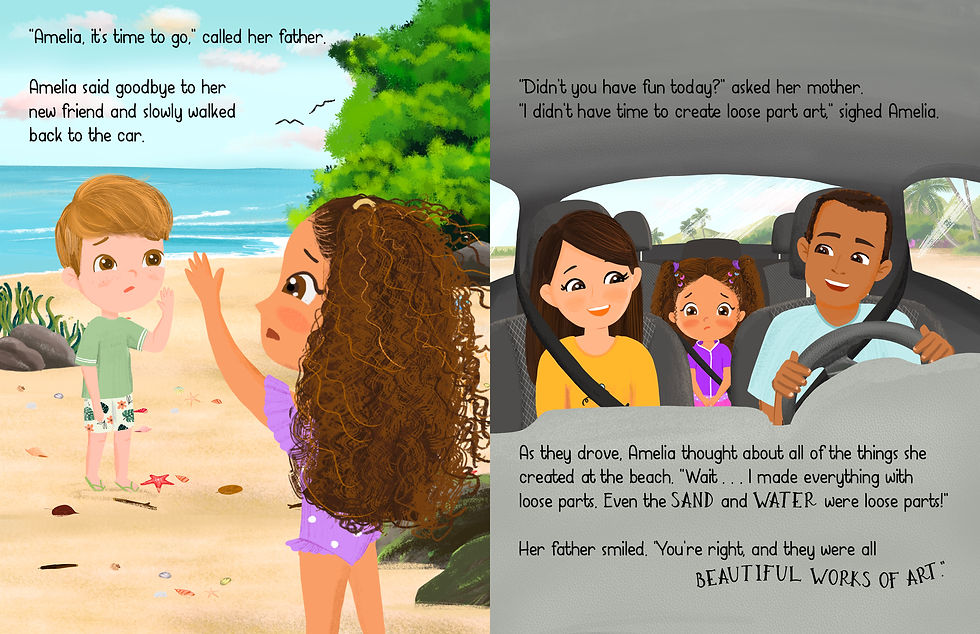
Through the series, Amelia quickly begins to view her surroundings differently. Buttons and fabric become art materials, sand and water become a solution, and logs and rocks become a playground. Now, the materials in her environment are possibilities she can use to bring her ideas to life.
For children, this shift is about learning to look around and ask, “What could I use?” For adults, it is a reminder that the materials we offer and the way we present them can either limit or expand children’s thinking.

How the Series Builds onto Itself
Each book in the series can be read as a stand-alone book, but they are intentionally designed to build on the child’s prior knowledge and understanding to scaffold their thinking and abilities with each book. Here are some of the messages and learning that come from each story:

Amelia’s Loose Part Art
· Learning what loose parts are for the first time
· Learning how to use loose parts specifically for
creating art
· Positive self-talk about creativity and viewing one’s self as an artist
· Modeling resilience to adapt when feeling disappointed
· Showing items used for a specific purpose being used in unexpected ways
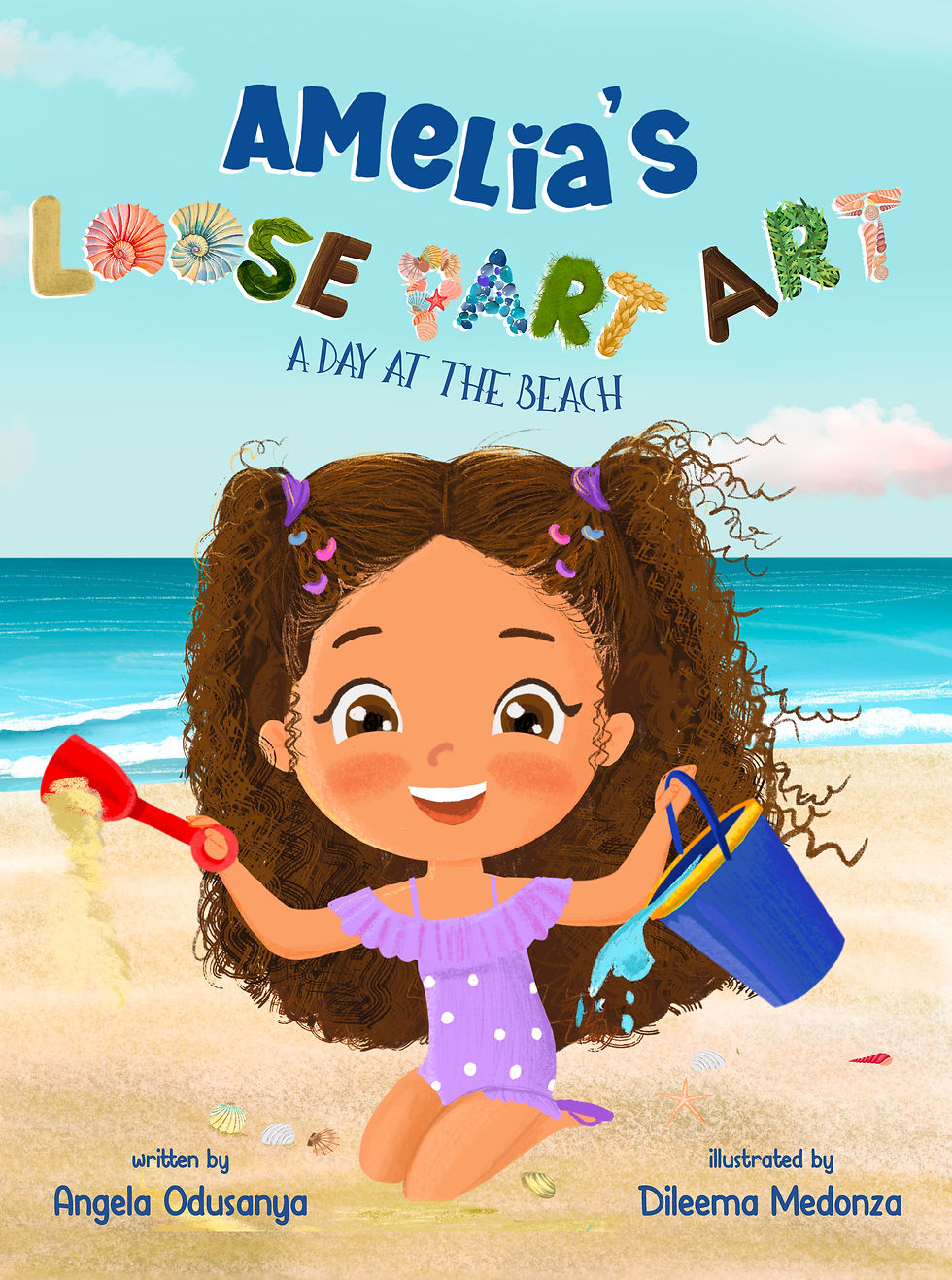
Amelia’s Loose Part Art: A Day at the Beach
· Learning that sensory items are also loose parts
· Learning that loose parts can be used to create solutions to problems
· Positive self-talk about trusting one’s own ideas to solve problems
· Modeling empathy for animals and people
· Showing how to apply what you learned in one context to another context
· Introduces small world play

Amelia’s Loose Part Art: A Night at the Campsite
· Learning that loose parts come in all sizes
· Learning that structures are also pieces of art
· Positive self-talk about creating your own happiness
· Modeling how teamwork can bring ideas to life
· Encourages outdoor, active play
· Introduces dramatic play themes at home
· Illustrations show how animals in nature use loose parts of survival and for play
What adults learn from the books
· How to support children when they experience frustration and disappointment
· How to organize a loose parts collection at home
· Each book has a grown-up guide at the back of the book with material and activity ideas
· More information on loose part art, sensory loose parts play, and large loose
parts play is also available on my website
Shop the collection on my website or on amazon.


Comments